
Why Some Indian Snack Brands Are Moving Away from Palm Oil
A growing number of Indian snack brands are dropping palm oil in favour of cold-pressed alternatives. Here's a balanced look at why — what the evidence actually shows, and where the picture is more nuanced than 'palm oil bad.'
Dr. Anjali Menon, RD
VerifiedBTC Nutrition & Culinary Team
# Why Some Indian Snack Brands Are Moving Away from Palm Oil
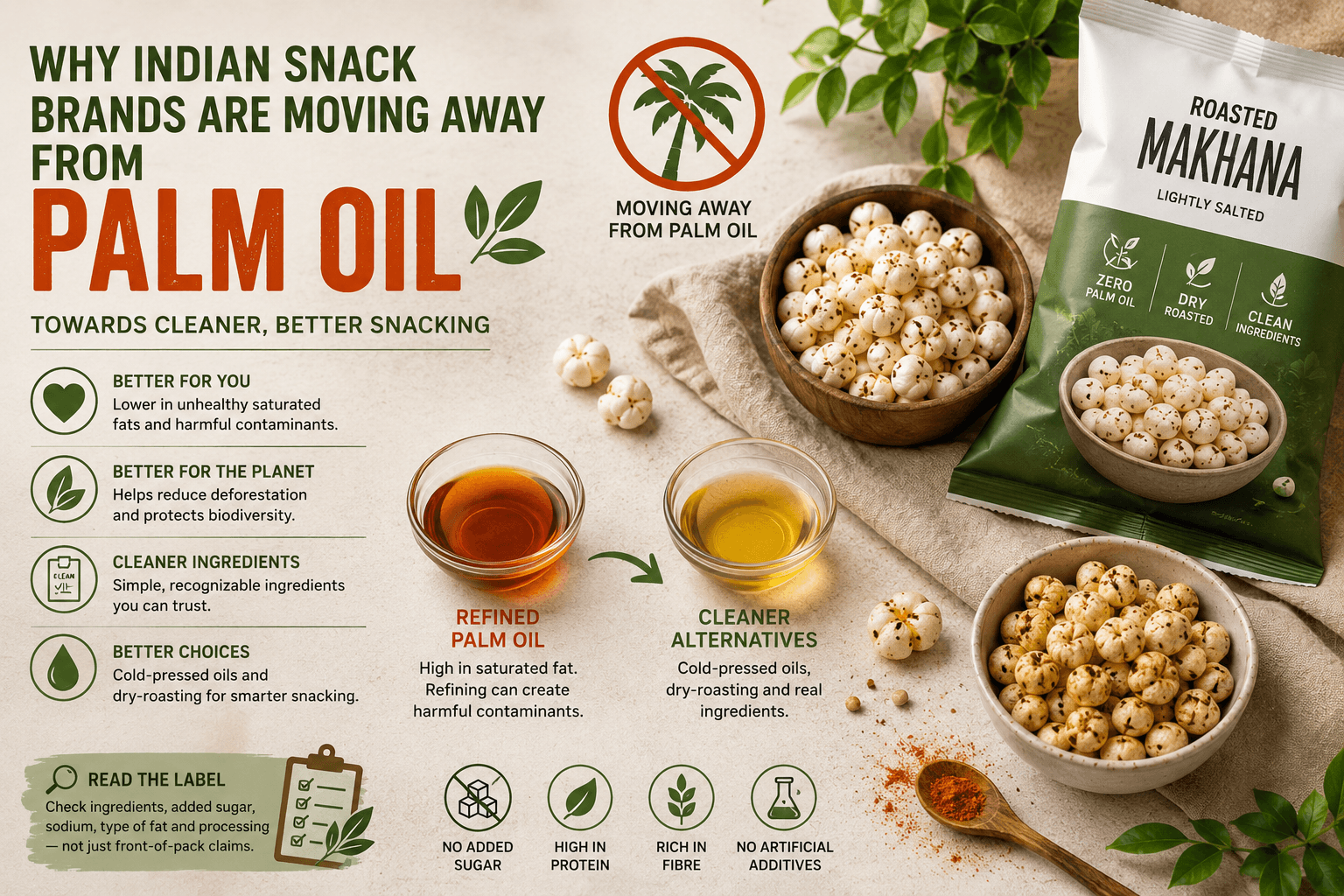
A growing number of Indian snack brands now advertise "zero palm oil" on their packaging. Some of the reasoning behind this shift is well supported by evidence; some of it is more marketing flourish than fact. This is a fair look at both sides.
Why Some Brands and Consumers Are Concerned About Palm Oil
Saturated fat content
Palm oil is relatively high in palmitic acid, a saturated fatty acid. Saturated fat intake is commonly linked to higher LDL ("bad") cholesterol, a recognised cardiovascular risk factor. It's worth noting, though, that the strength of the link between saturated fat intake and heart disease risk is still genuinely debated among nutrition scientists — the picture is more nuanced than a single fat source being simply "good" or "bad," and overall dietary pattern matters more than any one ingredient.
Refining contaminants: 3-MCPD and glycidyl esters
This is the most solid, evidence-backed concern. When vegetable oils — palm oil in particular — are refined at high temperatures (above roughly 200°C) during deodorisation, two contaminants can form: 3-MCPD esters and glycidyl esters (GE). The European Food Safety Authority (EFSA) has found that palm oil and palm fat typically contain the highest levels of both among common vegetable oils. Importantly, these two substances carry different types of risk: glycidyl esters (GE) are classified by EFSA as genotoxic and carcinogenic, while 3-MCPD itself is associated with potential risks to the kidneys and male reproductive system, not classified as carcinogenic in the same way. Both are worth minimising exposure to, but they aren't identical risks, and conflating them overstates the case.
It's also worth noting that regulators, including in the EU, have since set maximum permitted levels for these contaminants in refined oils, and manufacturers have made efforts to reduce them through improved refining methods — so "contains palm oil" does not automatically mean a product exceeds safety limits.
Environmental impact
Palm oil cultivation has been linked to significant deforestation and biodiversity loss, particularly in Southeast Asia, where much of the world's supply is grown. This is a well-documented environmental concern, separate from the direct health questions above. It's worth noting that certified sustainable palm oil (RSPO-certified) exists specifically to address this, and some brands that still use palm oil have shifted to certified sources rather than dropping it entirely — a middle-ground approach that gets less attention than the "zero palm oil" framing.
What "Clean Label" Snacking Generally Looks Like
Brands moving away from palm oil tend to share a few common approaches:
- 1Alternative fats or dry-roasting. Options include cold-pressed oils (like rice bran or olive oil) or dry-roasting without added oil. It's worth knowing that alternative oils have their own trade-offs — coconut oil, for instance, is also high in saturated fat, so switching away from palm oil doesn't automatically mean a lower-saturated-fat product.
- 2Whole-food ingredients over highly processed fillers, such as using whole legumes, nuts and seeds rather than extruded starches.
- 3Simpler flavouring, using actual spices, herbs or dried ingredients instead of synthetic flavour compounds.
- 4Clearer labelling, with protein, fibre and sugar content stated plainly rather than buried in fine print.
These are reasonable practices, though none of them are unique to palm-oil-free products specifically — a product can follow all four practices and still use palm oil, or avoid palm oil and still be high in sugar or heavily processed in other ways. "No palm oil" on a label isn't, by itself, a guarantee of a cleaner product overall.
How to Actually Evaluate a Packaged Snack
Rather than relying on a single ingredient callout, it's more useful to check:
- The full ingredient list, not just the front-of-pack claims
- Added sugar and sodium per serving
- The type and amount of fat used, saturated and otherwise
- Whether the product is minimally processed or uses many additives regardless of which oil is used
Frequently Asked Questions
Is palm oil actually bad for you?
It's mixed. Palm oil's saturated fat content is linked to higher LDL cholesterol, though the overall saturated-fat-and-heart-disease relationship is still debated in nutrition science. The clearer, better-supported concern is refining contaminants (3-MCPD and glycidyl esters) that form during high-temperature processing, and regulators have set permitted limits to manage this risk.
Are 3-MCPD and glycidyl esters both carcinogenic?
No — this is a common oversimplification. Glycidyl esters (GE) are classified as genotoxic and carcinogenic by EFSA. 3-MCPD itself is linked to potential risks to the kidneys and male reproductive system, not classified as carcinogenic in the same way.
Does avoiding palm oil make a snack automatically healthier?
Not automatically. A product can avoid palm oil and still be high in sugar, sodium or heavily processed in other ways, and alternative oils like coconut oil also carry a high saturated-fat content. Checking the full ingredient list and nutrition panel matters more than a single ingredient callout.
What is sustainable palm oil?
RSPO-certified sustainable palm oil is grown and processed under standards intended to reduce deforestation and biodiversity loss. Some brands choose certified palm oil rather than switching to an alternative fat entirely.
Final Takeaway
Some of the concern around palm oil is well founded, particularly around refining contaminants and deforestation. Some of it is oversimplified marketing shorthand that treats "palm oil" as a single villain while ignoring that other oils have their own trade-offs, and that a "zero palm oil" label doesn't automatically mean a genuinely clean product. The most useful habit isn't avoiding one ingredient — it's actually reading the full label.
Born To Crave uses dry-roasting and alternative oils across its snack range. Explore the [roasted makhana collection] to see this in practice.
This article is for general nutrition information only and is not a substitute for personalised medical or dietary advice.
Sources: European Food Safety Authority (EFSA) scientific opinions on 3-MCPD, 2-MCPD and glycidyl esters in food (2016, 2018); general nutrition literature on saturated fat and cardiovascular risk, presented with the caveat that this remains a debated area of nutrition science.
Dr. Anjali Menon, RD
BTC Editorial & Nutrition TeamThe Born To Crave Editorial and Food Science Team crafts deep-dive nutritional guides, culinary research, and healthy snacking breakdowns for wellness-focused consumers across India.
Continue Reading
More expert guides in Industry Insights
Never Miss a Healthy Snacking Breakthrough
Get scientifically backed nutritional breakdowns, healthy 5-minute recipes, and exclusive discount codes directly in your inbox.