
Are Vegetable Chips Good for You? What the Evidence Actually Shows
Vegetable chips carry a health halo, but many are made mostly from potato starch, not real vegetables. Here's what the ingredient list, nutrition label and actual research say about whether they're healthier than regular chips.
\
VerifiedBTC Nutrition & Culinary Team
# Are Vegetable Chips Good for You? What the Evidence Actually Shows
Vegetable chips are marketed as the smarter alternative to potato chips — colourful, "veggie-powered," and an easy way to sneak in extra nutrients. The reality is more mixed. Whether a specific bag of vegetable chips is actually good for you depends heavily on what it's made from and how it's cooked, and several popular products don't hold up well once you read the label closely.
The "Health Halo" Problem
Nutrition researchers use the term "health halo effect" to describe how a product's branding, packaging or category name ("veggie") can make people assume it's healthier than it actually is, independent of what's really in it. An analysis by a UK registered nutritionist found that some vegetable chip products are only around 65% actual vegetables, with the rest made up of oil and salt — nutritionally not far from a bag of potato chips, and in some cases higher in fat.
A common finding across nutrition reviews: many "veggie" chips and straws list potato starch or potato flour as the primary ingredient, with vegetable powder (spinach, tomato, beet) appearing much further down the list — meaning the product's colour comes from a small amount of vegetable powder, not a meaningful vegetable content.
What Actually Makes a Vegetable Chip Healthier (or Not)
1. Whether it's fried or baked/dehydrated
This is the single biggest factor. Deep-fried vegetable chips pick up significant added fat during frying and can end up with a similar or higher fat content than potato chips. Baked or dehydrated vegetable chips retain more of the vegetable's natural fibre and nutrients without the added frying oil.
2. Where the vegetable sits on the ingredient list
Ingredients are listed by weight, from most to least. If a starch (potato starch, tapioca starch, corn starch) appears before the named vegetable, the product is mostly starch with vegetable flavouring and colour added — not a vegetable-based snack in any meaningful sense.
3. Sodium and fat per serving
A reasonable benchmark used by dietitians is under about 200 mg of sodium per serving, alongside at least a few grams of fibre. Many packaged vegetable chips exceed this comfortably, especially flavoured varieties.
4. Acrylamide, in context
Frying starchy foods (potatoes and, to a lesser extent, some root vegetables) at high temperatures can form acrylamide, a compound that has been linked in some research to increased health risks with long-term, heavy exposure. This applies broadly to fried starchy snacks, not specifically to "vegetable" chips versus potato chips — it's a reason to moderate any deep-fried starchy snack, rather than a reason to avoid vegetable chips specifically while trusting potato chips less, or vice versa.
A Myth Worth Correcting: "Frying Oil Turns Into Trans Fat"
You'll see this claim repeated in some vegetable-chip content: that heating oils like canola for frying converts them into trans fat. This isn't well supported. A Canadian Journal of Dietetic Practice study heated canola oil to 527°F — well past its smoke point — and found no meaningful trans fat formation. A separate peer-reviewed study testing baking, stir-frying and deep-frying similarly found no significant increase in trans fats under normal cooking conditions. Frying does have real downsides (added calories, potential acrylamide formation, nutrient loss from oxidation at very high heat), but "it turns into trans fat" isn't one of them — worth knowing so you're evaluating chips on the factors that actually matter.
How Vegetable Chips Compare: A Rough Guide
| Type | Typical fat content | Typical sodium | Fibre retained | Notes |
|---|---|---|---|---|
| Regular potato chips (fried) | High | High | Low | The baseline most people are trying to "upgrade" from |
| Fried vegetable chips (potato-starch-based) | High, sometimes similar to potato chips | High | Low | Often the least different from potato chips despite branding |
| Fried vegetable chips (whole vegetable, e.g. banana, jackfruit — common in India) | High | Moderate–high | Moderate | Real vegetable/fruit content, but still deep-fried |
| Baked or dehydrated vegetable chips | Low–moderate | Varies by brand | Higher | Best balance of real vegetable content and lower added fat |
| Homemade baked vegetable chips | Low (you control the oil) | Low (you control the salt) | Highest | Most control, least convenient |
Figures are general comparisons, not fixed values — always check the specific product's nutrition label.
Vegetable Chips in the Indian Market
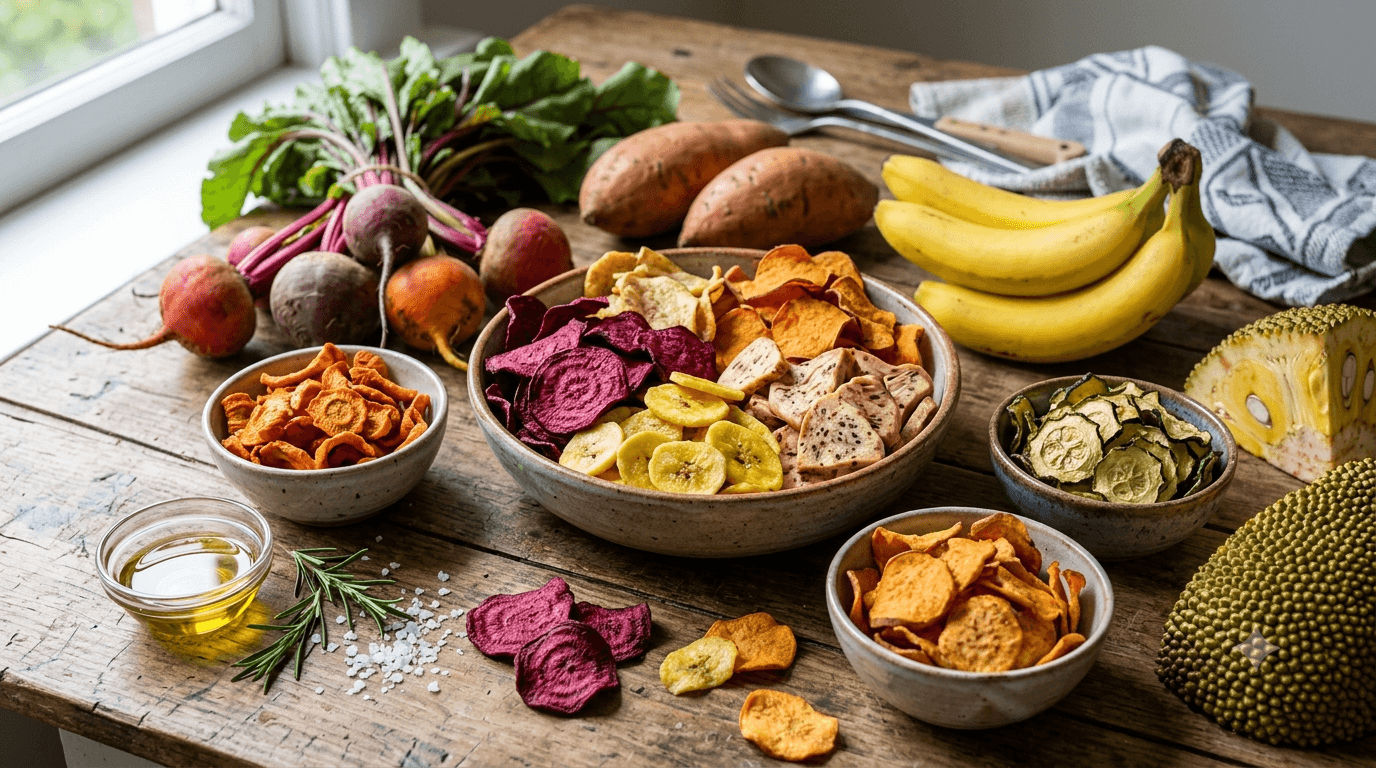
In India, "vegetable chips" often means something a little different from Western veggie-straw products — think banana chips, jackfruit chips, tapioca chips and mixed vegetable chips, which are traditionally deep-fried in oil (often coconut oil in South India) rather than baked. These do typically contain a genuinely high proportion of the named vegetable or fruit, unlike some Western potato-starch-based veggie straws — but being deep-fried, they still carry the same fat and calorie considerations as any fried snack. As with any packaged snack sold in India, check for an FSSAI license number and read the nutrition panel rather than assuming "vegetable" on the label means low-fat.
A Simple Checklist Before Buying
- Is a vegetable (not a starch) the first or second ingredient?
- Is it baked or dehydrated rather than deep-fried?
- Is sodium under roughly 200 mg per serving?
- Does it have a few grams of fibre per serving?
- Is the ingredient list short and recognisable?
If a product fails most of these, it's reasonable to treat it as a flavoured version of a regular fried snack rather than a genuinely healthier vegetable-based option.
Making Your Own Baked Vegetable Chips
If you want full control over oil and salt, homemade baked vegetable chips are straightforward:
- 1Wash and thinly slice your vegetable of choice (sweet potato, beetroot, carrot or zucchini all work well) using a mandoline or sharp knife for even thickness.
- 2Pat the slices dry to remove excess moisture, then arrange in a single layer on a lined baking tray.
- 3Lightly drizzle with oil and season with herbs or spices, then bake at around 160–180°C (320–350°F) for 20–35 minutes, turning halfway, until crisp.
Homemade chips won't have the shelf life of packaged ones, but they let you skip the starch fillers entirely.
Frequently Asked Questions
Are vegetable chips actually healthier than potato chips?
Not automatically. Many packaged vegetable chips are made primarily from potato starch with a small amount of vegetable powder for colour and flavour, and fried versions can have a similar fat and sodium content to regular potato chips. Baked or dehydrated vegetable chips, or products where a real vegetable is the first ingredient, are generally the better choice.
Do vegetable chips count toward my daily vegetable intake?
Not meaningfully in most cases. The vegetable content in many packaged vegetable chips is too low, and the processing removes much of the fibre and nutrients you'd get from eating the whole vegetable.
Are banana chips or jackfruit chips healthy?
They typically contain a genuinely high proportion of the named fruit or vegetable, unlike some potato-starch-based veggie straws, but they are usually deep-fried, so they still carry a similar fat and calorie profile to other fried snacks. Moderation and portion size matter regardless of the vegetable content.
Does frying oil turn into trans fat?
No — this is a common but inaccurate claim. Studies testing oils like canola even at temperatures well past their smoke point found no meaningful trans fat formation from normal cooking or frying.
What should I check on a vegetable chip label before buying?
Check whether a vegetable (not a starch) is the first or second ingredient, whether the product is baked or dehydrated rather than fried, sodium content (aim for under roughly 200 mg per serving), and fibre content.
Final Takeaway
Some vegetable chips are genuinely a better choice than potato chips; many are not, despite the branding. The deciding factors are whether a real vegetable is the primary ingredient, whether the product is baked or fried, and what the sodium and fat numbers actually say — not the word "vegetable" on the front of the pack. Read the label the same way you would for any packaged snack, and treat vegetable chips as an occasional snack rather than a stand-in for eating actual vegetables.
This article is for general nutrition information only and is not a substitute for personalised medical or dietary advice.
Sources: Nutritionist analysis reported by The Healthy (Wren Kitchens); Cleveland Clinic dietitian commentary reported by TIME; Canadian Journal of Dietetic Practice study on canola oil and trans fat formation; peer-reviewed study on trans fat formation during food preparation (PubMed).
\
BTC Editorial & Nutrition TeamThe Born To Crave Editorial and Food Science Team crafts deep-dive nutritional guides, culinary research, and healthy snacking breakdowns for wellness-focused consumers across India.
Continue Reading
More expert guides in Nutrition

Never Miss a Healthy Snacking Breakthrough
Get scientifically backed nutritional breakdowns, healthy 5-minute recipes, and exclusive discount codes directly in your inbox.